In the Bulletin: Ramblings Through the High Sierra
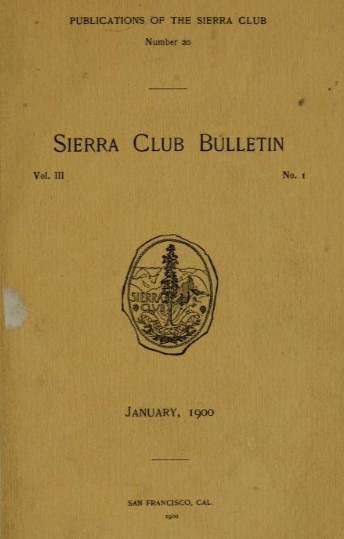
When I consider the various Sierra Club Bulletin articles from the early years, this one stands out. Not only in length, 107 pages total, but also in detail. It’s a first-hand account of Joseph LeConte’s first trip to Yosemite during the summer of 1870. The words are captured in Sierra Club Bulletin Volume 3 No. 1 January 1900 titled “Ramblings Through the High Sierra”. If you have time, go to the source and read the full piece.
I’ve included a trip overview below to help with your bearings and a few excerpts to pique your interest.
Ramblings Through the High Sierra:
July 21- The journey begins departing Oakland
July 22- En route to the Sierra Nevada
July 29- Started for the Big Trees (Mariposa Grove)
July 30- First view of Yosemite
August 1 – Inspiration Point
August 2 – Yosemite Valley
August 3 – Vernal and Nevada Falls
August 5 – Yosemite Falls and meeting John Muir
August 6 – Mirror Lake
August 8 – Leaving Yosemite Valley
August 9 – Lake Tenaya
August 10 – Tuolumne Meadows
August 12 – Mount Dana
August 21 – Lake Tahoe
July 28, 1870 – “Our trip, thus far, has been one of hardship without reward. It has been mere endurance, in the hope of enjoyment. Some enjoyment, it is true, —our camps, our morning and evening rides, our jokes, etc. , — but nothing in comparison with the dust and heat and fatigue. From this time we expect to commence the real enjoyment. We are delightfully situated here at Clark’s; fine pasture for horses; magnificent grove of tall pines for camp; fine river — South Fork of Merced — to swim in; delightful air. We determined to stop here two days; one for rest and clothes-washing, and one for visiting the Big Trees. I have been sufficiently long with the party to become well acquainted with all. I have nothing to do, to-day, except to wash my clothes. I cannot have a better opportunity to describe our party. I do it very briefly.
We are ten in number. Each man is dressed in strong trousers, heavy boots or shoes, and loose flannel shirt; a belt, with pistol and butcher-knife, about the waist; and a broad-brimmed hat. All other personal effects (and these are made as few as possible) are rolled up in a pair of blankets and securely strapped behind his saddle. Thus accoutered, we make a formidable appearance, and are taken sometimes for a troop of soldiers, but more often for a band of cattle or horse drovers. Our camp utensils consist of two large pans, to mix bread; a camp-kettle, a teapot, a dozen tin plates, and ten tin cups; and most important of all, two or three frying-pans. The necessary provisions are bacon, flour, sugar, tea, and coffee. Whenever we could, we bought small quantities of butter, cheese, fresh meat, potatoes, etc. Before leaving Oakland we organized thoroughly, by electing Soule as our Captain, and Hawkins his Lieutenant, and promised implicit obedience. This promise was strictly carried out. All important matters, however, such as our route, how long we should stay at any place, etc., was decided by vote, the Captain preferring to forego the exercise of authority in such matters.”
July 29, 1870 — “Started for the Big Trees at 7 a. m. Five of the party walked, and five rode. I preferred riding, and I had no cause to regret it. The trail was very rough, and almost the whole way up-mountain; the distance about six miles, and around the grove two miles, making fourteen miles in all. The walkers were very much heated and fatigued, and drank too freely of the ice-cold water of the springs. The abundance and excessive coldness of the water seem closely connected with the occurrence of these trees.
My first impressions of the Big Trees were somewhat disappointing; but, as I passed from one to another; as, with upturned face, I looked along their straight, polished shafts, towering to the height of three hundred feet; as I climbed up the sides of their prostrate trunks, and stepped from end to end; as I rode around the standing trees and into their enormous hollows; as we rode through the hollows of some of these prostrate trunks, and even chased one another on horseback through these enormous, hollow cylinders, a sense of their immensity grew upon me. If they stood by themselves on a plain, they would be more immediately striking. But they are giants among giants. The whole forest is filled with magnificent trees, sugar pines, yellow pines, and spruce, eight to ten feet in diameter, and two hundred to two hundred and fifty feet high. The sugar pine, especially, is a magnificent tree in size, height, and symmetry of form.
Of all the big trees of this grove, and, therefore, of all the trees I have ever seen, the Grizzly Giant impressed me most profoundly; not, indeed, by its tallness or its symmetry, but by the hugeness of its cylindrical trunk, and by a certain gnarled grandeur, a fibrous, sinewy strength, which seems to defy time itself. The others, with their smooth, straight, tapering shafts, towering to the height of three hundred feet, seemed to me the type of youthful vigor and beauty in the plentitude of power and success. But this, with its large, rough, knobbed, battered trunk, more than thirty feet in diameter — with top broken off and decayed at the height of one hundred and fifty feet — with its great limbs, six to eight feet in diameter, twisted and broken — seemed to me the type of a great life, decaying, but still strong and self-reliant. Perhaps my own bald head and grizzled locks — my own top, with its decaying foliage — made me sympathize with this grizzled giant; but I found the Captain, too, standing with hat in hand, and gazing in silent, bare-headed reverence upon the grand old tree.”
July 30, 1870-: “In the afternoon we pushed on, to get our first view of Yosemite this evening, from Sentinel Dome and Glacier Point. Passing Paragoy’s, I saw a rough-looking man standing in an open place, with easel on thumb, and canvas before him, alternately gazing on the fine mountain view and painting. “Hello! Mr. Tracy, glad to see you.” “Why, Doctor, how do you do? where are you going ? ” “Yosemite, the High Sierra, Lake Mono, and Lake Tahoe.” “Ah! how I wish I could go with you.” After a few such pleasant words of greeting and inquiry, I galloped on, and overtook our party on the trail to Glacier Point. About 5 p. M. we passed a high pile of rocks, called Ostrander’s Rocks. The whole trail, from Westfall’s Meadows to Glacier Point, is near eight thousand feet high. From this rocky prominence, therefore, the view is really magnificent. It was our first view of the Peaks and Domes about Yosemite, and of the more distant High Sierra, and we enjoyed it beyond expression. But there are still finer views ahead, which we must see this afternoon—yes, this very afternoon. With increasing enthusiasm we pushed on until, about 6 P. m. , we reached and climbed Sentinel Dome. This point is four thousand five hundred feet above Yosemite Valley, and eight thousand five hundred feet above the sea. The view which here burst upon us, of the Valley and the Sierra, it is simply impossible to describe. Sentinel Dome stands on the south margin oi Yosemite, near the point where it branches into three canons. To the left stands El Capitan’s massive perpendicular wall; directly in front, and distant about one mile, Yosemite Falls, like a gauzy veil, rippling and waving with a slow, mazy motion; to the right the mighty granite mass of Half Dome lifts itself in solitary grandeur, defying the efforts of the climber; to the extreme right, and a little behind, Nevada Fall, with the cap of Liberty ; in the distance, innumerable peaks of the High Sierra, conspicuous among which are Cloud’s Rest, Mt. Starr King, Cathedral Peak, etc. We remained on the top of this Dome more than an hour, to see the sunset. We were well repaid — such a sunset I never saw; such a sunset, combined with such a view, I had never imagined. The gorgeous golden and crimson in the west, and the exquisitely delicate, diffused rose-bloom, tingeing the cloud caps of the Sierra in the east, and the shadows of the grand peaks and domes slowly creeping up the valley! I can never forget the impression. We remained, enjoying this scene, too long to think of going to Glacier Point this evening. We therefore put this off until morning, and returned on our trail about one and a half miles, to a beautiful green meadow, (Hawkins had chosen it on his way to Sentinel Dome), and there made camp in a grove of magnificent fir-trees {Abies magnijica).”
July 31, 1870: Sunday. — “I got up at peep of day this morning, (I am dish wash to-day,) roused the party, started a fire, and in ten minutes tea was ready. All partook heartily of this delicious beverage, and started on foot to see the sunrise, from Glacier Point. This point is about one and a half miles from our camp, about three thousand two hundred feet above the valley, and forms the salient angle on the south side, just where the valley divides into three. We had to descend about eight hundred feet to reach it. We arrived just before sunrise. Sunrise from Glacier Point! No one can appreciate it who has not seen it. It was our good fortune to have an exceedingly beautiful sunrise. Rosy-fingered Aurora revealed herself to us, her votaries, more bright and charming and rosy than ever before. But the great charm was the view of the valley and surrounding peaks, in the fresh, cool morning hour and in the rosy light of the rising sun; the bright, warm light on the mountain tops, and the cool shade in the valley. The shadow of the grand Half Dome stretches clear across the valley, while its own ‘ ‘ bald, awful head ‘ ‘ glitters in the early sunlight. To the right. Vernal and Nevada Falls, with their magnificent, overhanging peaks, in full view; while directly across, see the ever-rippling, ever-swaying, gauzy veil of the Yosemite Fall, reaching from top to bottom of the opposite cliff, two thousand six hundred feet. Below, at a depth of three thousand two hundred feet, the bottom of the valley lies like a garden. There, right under our noses, are the hotels, the orchards, the fields, the meadows (near one of these Hawkins even now selects our future camp), the forests, and through all the Merced River winds its apparently lazy, serpentine way. Yonder, up the Tenaya Canon, nestling close under the shadow of Half Dome, lies Mirror Lake, fast asleep, her polished, black surface not yet ruffled by the rising wind. I have heard and read much of this wonderful valley, but I can truly say I have never imagined the grandeur of the reality.”
“After breakfast we returned to Glacier Point, and spent the whole of the beautiful Sunday morning in the presence of grand mountains, yawning chasms, and magnificent falls. What could we do better than allow these to preach to us? Was there ever so venerable, majestic, and eloquent a minister of natural religion as the grand old Half Dome? I withdrew myself from the rest of the party and drank in his silent teachings for several hours. About 1 p.m. climbed Sentinel Dome, and enjoyed again the matchless panoramic view from this point, and about 2 p.m. returned to camp.
Our camp is itself about four thousand feet above the valley, and eight thousand above sea-level. By walking about one hundred yards from our camp-fire, we get a most admirable view of the Sierra, and particularly a most wonderfully striking view of the unique form of Half Dome, when seen in profile. I enjoyed this view until nearly time to saddle up.”
August 8, 1870: “After supper, I went with Mr. Muir and sat on a high rock, jutting into the lake. It was full moon. I never saw a more delightful scene. This little lake, one mile long and a half mile wide, is actually embosomed in the mountains, being surrounded by rocky eminences two thousand feet high, of the most picturesque forms, which come down to the very water’s edge. The deep stillness of the night ; the silvery light and deep shadows of the mountains; the reflection on the water, broken into thousands of glittering- points by the ruffled surface; the gentle lapping of the wavelets upon the rocky shore — all these seemed exquisitely harmonized with each other, and the grand harmony made answering music in our hearts. Gradually the lake surface became quiet and mirror-like, and the exquisite surrounding scenery was seen double.”
August 21, 1870: Sunday, — “Sunday at Tahoe! I wish I could spend it in perfect quiet. But my underclothes must be changed. Cleanliness is a Sunday duty. Some washing is necessary. Some of the party went fishing to-day. The rest of us remained in camp and mended or washed clothes.
At 12 M. I went out alone, and sat on the shore of the lake, with the waves breaking at my feet. How brightly emerald-green the waters near the shore, and how deeply and purely blue in the distance! The line of demarcation is very distinct, showing that the bottom drops off suddenly. How distinct the mountains and cliffs all around the lake; only lightly tinged with blue on the farther side, though more than twenty miles distant!
How greatly is one’s sense of beauty affected by associations! Lake Mono is surrounded by much grander and more varied mountain scenery than this; its waters are also very clear, and it has the advantage of several picturesque islands; but the dead volcanoes, the wastes of volcanic sand and ashes covered only by interminable sagebrush , the bitter, alkaline, dead, slimy waters, in which nothing but worms live; the insects and flies which swarm on its surface, and which are thrown upon its shore in such quantities as 10 infect the air, — all these produce a sense of desolation and death which is painful; it destroys entirely the beauty of the lake itself; it unconsciously mingles with and alloys the pure enjoyment of the incomparable mountain scenery in its vicinity.
On the contrary, the deep-blue, pure waters of Lake Tahoe, rivaling in purity and blueness the sky itself; its clear, bright emerald shore waters, breaking snowwhite on its clean rock and gravel shores; the lake basin, not on a plain, with mountain scenery in the distance, but counter-sunk in the mountain’s top itself, — these produce a never-ceasing and ever-increasing sense of joy, which naturally grows into love.
Closing Thoughts:
Whenever I approach the Bulletin, I read carefully, slowly, expectantly, knowing there is gold in the words.
In modern times we can transit from the Bay Area to the Valley in 3-5 hours in a climate-controlled luxury machine with wifi and unlimited potential for distraction. In 1870 it was an arduous journey of dust, heat, and fatigue. LeConte’s words help us understand the effort that was required to access the Sierra Nevada in the 19th century.
The gear list has changed, we are now ultralight and carry portable batteries to power our digital contraptions. But even in the present day, with our sub-ten pound base weight, we stand beneath the same sky, just two ears, just two eyes.
I enjoyed LeConte’s contemplation and reflection, standing before the Grizzly Giant, empathizing. Seeing himself in it.
LeConte’s reflection sitting lakeside with Muir is fascinating; just a rock, just a lake, but something transcendent transpires.
I share all the above because I think there is value in hearing the perspective of another age, ruminating on their thoughts and contemplating their passions. The words are not dead but stir our hearts and flood our minds. We return, again and again, not knowing what we will find.